
Investment casting, also known as lost-wax casting, is a centuries-old manufacturing process that remains critical to modern industry. Known for its precision, surface finish, and ability to produce complex shapes, investment casting is widely used in industries ranging from aerospace and automotive to medical and defense.
What is Investment Casting?
Investment casting is a process in which a wax model of a part is created, coated with ceramic to form a mold, and then heated to remove the wax. Molten metal is then poured into the ceramic shell, forming a highly accurate metal component once cooled and the shell is broken away.
This method allows for the creation of parts with intricate geometries and fine details that would be difficult or impossible to achieve through traditional machining or sand casting.
The Investment Casting Process: Step-by-Step
- Wax Pattern Creation – A replica of the desired part is made using wax. For large production runs, these wax patterns are often created using aluminum dies.
- Pattern Assembly – Multiple wax patterns can be attached to a central wax sprue to form a tree. This allows for multiple parts to be cast at once.
- Ceramic Shell Building – The wax tree is repeatedly dipped into a ceramic slurry and coated with fine sand. After several layers, a hard ceramic shell forms around the wax.
- Dewaxing – The ceramic shell is heated in an autoclave or furnace to melt and drain the wax—leaving a hollow mold.
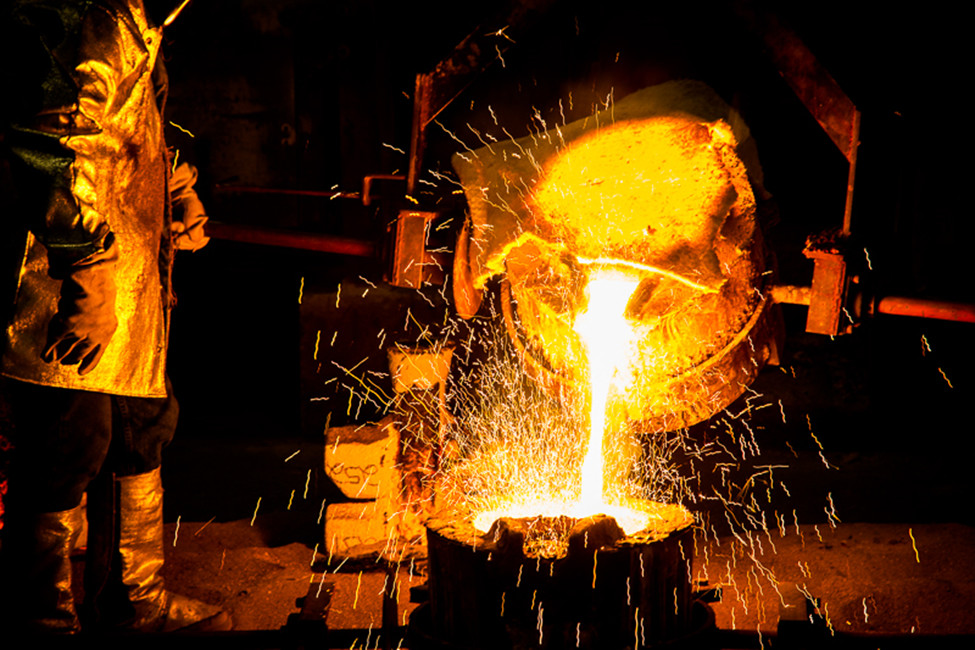
- Metal Pouring – The shell is preheated and molten metal (e.g., steel, aluminum, bronze) is poured into the mold.
- Shell Removal – Once cooled, the ceramic shell is broken away, revealing the cast metal part.
- Cutting and Finishing – The individual parts are cut from the sprue and undergo finishing operations such as grinding, heat treating, machining, or surface treatments.


Made in the USA.
Advantages of Investment Casting
- Design Flexibility – Complex shapes, undercuts, and fine details can be achieved.
- Excellent Surface Finish – Minimal machining required post-casting.
- Tight Tolerances – Dimensional accuracy is superior to other casting methods.
- Material Versatility – Suitable for a wide range of ferrous and non-ferrous alloys.
- Reduced Waste – Near-net-shape production minimizes material use and machining.


Made in the USA.
Common Applications
- Aerospace – Turbine blades, housings, and brackets.
- Automotive – Gearboxes, engine components, and turbocharger parts.
- Medical – Orthopedic implants, surgical instruments.
- Military & Defense – Weapon components, casings, and structural parts.
- Industrial Equipment – Pumps, valves, and impellers.


Limitations of Investment Casting
While investment casting offers many benefits, it does have some drawbacks:
- Higher Cost – Tooling and production costs are typically higher than sand casting, especially for low-volume runs.
- Longer Lead Time – The process is multi-step and sometimes a longer lead time to start-up, which depends on the complexity of part and tooling. You have options.
- Size Limitations – More suited for smaller parts due to mold and shell constraints, but we can produce larger castings up to 200 pounds and over.
The Future of Investment Casting
The integration of 3D printing with investment casting is transforming the process. Wax or resin patterns can now be directly printed, eliminating the need for tooling and enabling rapid prototyping and customization.
As demand for precision and efficiency grows, investment casting remains a cornerstone of high-quality manufacturing, bridging the gap between art and engineering.
We Think the Future is Now
Investment casting is a time-tested yet continually evolving process that delivers high-precision, complex parts for critical applications. Its unmatched combination of accuracy, surface finish, and design flexibility ensures it will remain a vital part of manufacturing well into the future.
 Precision Machining: Where Accuracy Meets Innovation